Monouchi

The Field

One swordsman. An endless field.

A masterless swordsman holds an open field in feudal Japan against waves of attackers that arrive from every bearing and never stop. There is no final wave and no way to win. Every run ends the same way. The question is how many you take with you.

Coming soon to the App Store In development for Android
The start screen of Monouchi: The Field

Screenshot to come.

The pitch

The part that actually cuts

Monouchi is the last third of a katana's edge — the part that actually cuts. The Field is that idea made playable: the classic scene of one swordsman against an army, with nothing between you and the crowd but where you stand and how you cut.

It is deliberately small. No story, no levelling, no saves, no inventory — one ronin, one blade, and a field that never empties. You are faster than everything that hunts you, so you can always run. Running solves nothing. The waves keep their own count, and half of each one lands ahead of the way you are fleeing.

When you fall, the tally reads how many fell by your blade, and you restart from zero. No respawn, no checkpoint.

The combat

Four cuts, and each one is a choice

Attacks are directional and independent of where you face — you can cut behind you without turning. Slashes buy breathing room. Stabs buy reach and double damage, but they demand aim.

The four attacks
Cut Arc Damage What it is for
Slash — forward 200° 1 Breathing room. A slash clears everything close enough to reach you, across more than half the field at once.
Back slash 200° 1
Stab — forward 50° 2 Reach. A stab lands from outside anything's swing — a free hit at double damage, if you aim it.
Back stab 50° 2

A guard you must point

The guard covers a 130° arc in front of you and nowhere else, takes a beat to come up, and holds exactly three blows. A blocked blow is negated outright. Empty the guard and it breaks — you are staggered with nothing available while everything lands in full.

A dodge you must commit to

The roll goes the way you were steering and cannot be turned once it starts. A short window of it cannot be touched; the rest of it can. Rolling everywhere is slower than walking. Read the wind-up, then commit.

Monouchi, the stroke

The super is charged only by landing hits — eighteen of them — never by a timer. One full turn of the body that fells everything within reach. It is a way out of a corner, not a way to win: the blade in your hands is still the strongest thing you carry.

Turtling does not stall the field, and neither does fleeing. A blocked or dodged blow draws no blood, and the field notices when nobody is bleeding.

The crowd

Read them before they reach you

One rule governs the casting: visible armour tells you how hard something is to kill, before it reaches you.

The three tiers
Tier Silhouette What it means
Levy Straw hats, hoods, bare heads — spears, sickles, staves The men a warlord sends first. One cut each, and there are always more of them.
Samurai A crested helmet, a katana Faster, harder to put down, and worth interrupting.
Elite Horned helmet and a war mask — the only dark figure on the field Hits for double, reaches further, closes faster. Three stabs, or six slashes, or a mistake.

Crest means samurai. Horns and a mask mean elite. There are no exceptions, and there is nothing to hover or inspect — you read the field the way a swordsman would, by looking at it. Every wind-up is telegraphed twice, once to the eye and once to the ear, and every enemy is a body that must reach you. There are no archers and no projectiles.

The waves never stop, and later ones send harder company. As the field thickens, the pressure is not how many stand against you — it is how fast the field refills the hole you cut.

The field

Ground worth holding

The field is one hundred metres of authored ground: rolling hills, a wadeable stream, two raked zen courts, a lantern-lit torii approach, and four buildings you can enter — and be followed into.

Wading the stream slows you; it does not slow them. The doorways are the point: a doorway is a choke a lone swordsman can hold against a crowd, which is the whole fantasy of this game expressed as level geometry.

The shrine hall

At the head of the torii approach — walk the lantern path, through the gate, straight in the front door. The largest interior in the game, with a second door on the east wall, so holding the front is never safe.

The farmhouse

Doors on adjacent walls — a corner you fight through rather than a box you hide in.

The choke

The east hamlet house. In the front door, out the back, into the narrowest gap on the map — if you know where you are going.

The pocket

The west hamlet house has one door, deliberately. The doorway is yours to hold and nothing can flank you — right up until you need to leave through the crowd you just stacked into it.

Indoors is a good option, not a winning one. Nothing on this field wins for you.

The look

Ink, paper, and the field carrying the drama

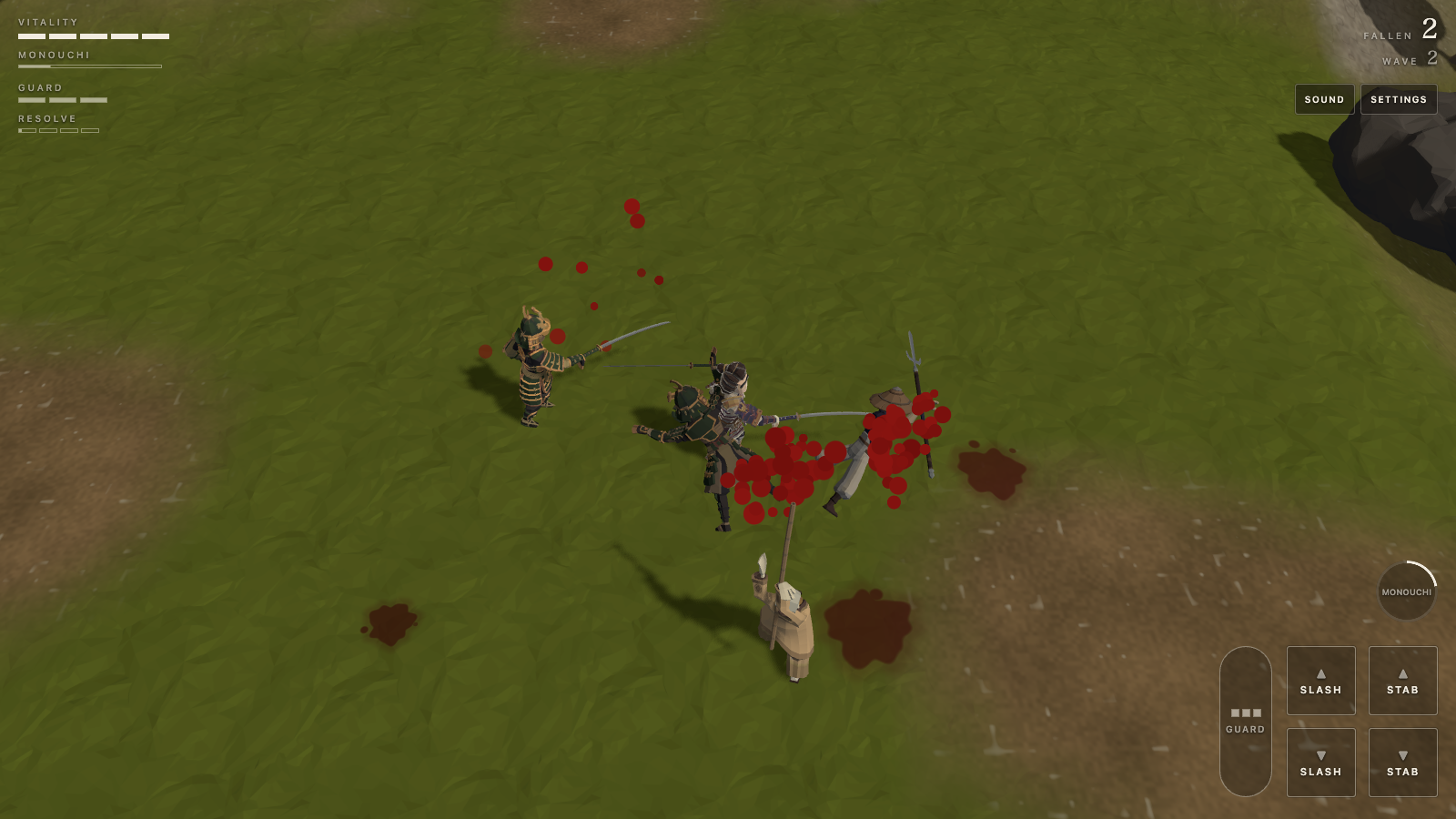
Early combat on an open green field: the swordsman lands a slash in a spray of blood while a samurai and a spearman close in.

Screenshot to come.

A slash buys breathing room.
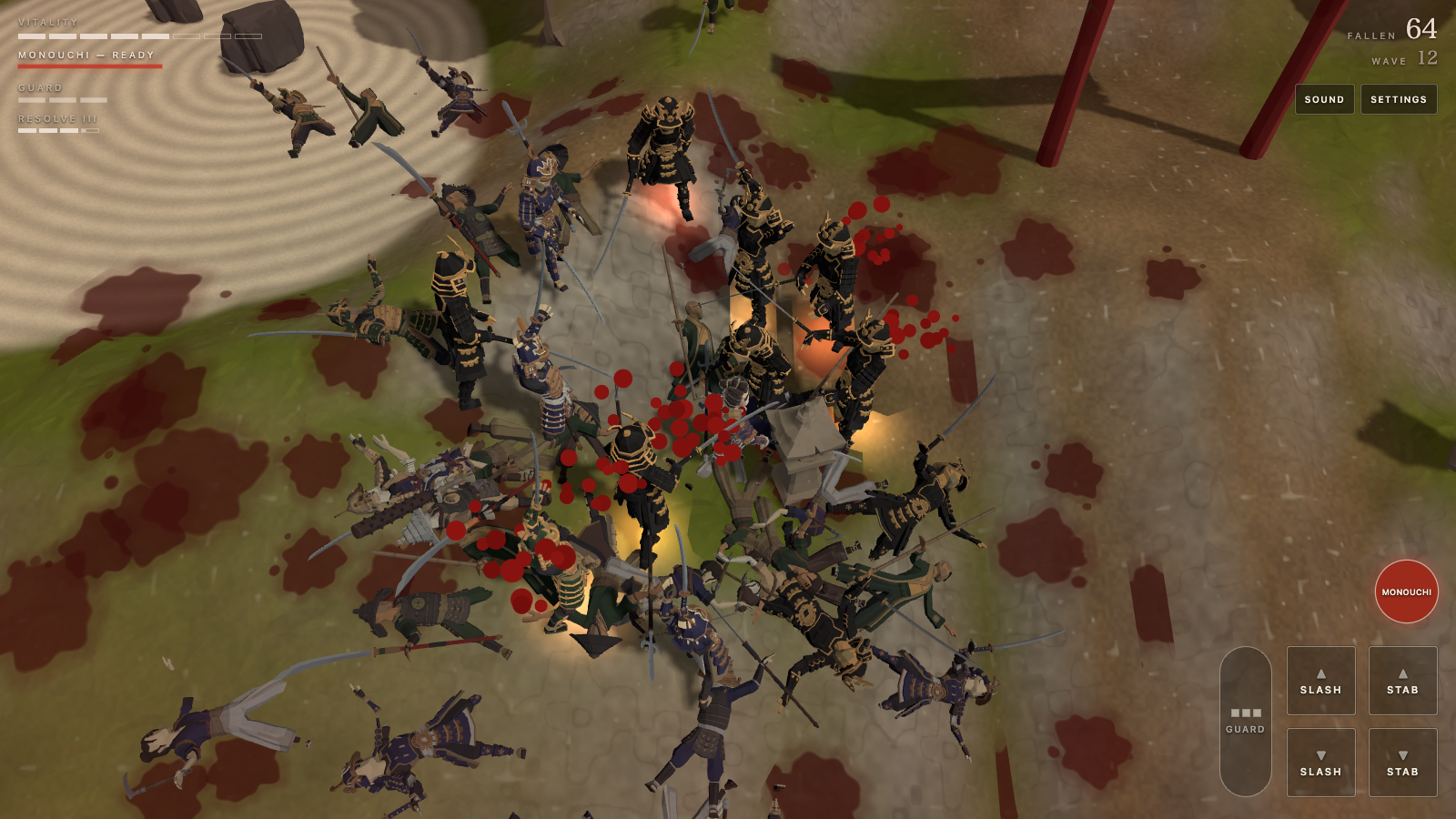
The swordsman surrounded in a crowd melee

Screenshot to come.

The field never empties.
Difficulty

Three ways to meet the field

Chosen on the title card, changeable mid-run. The blurbs below are the game's own text.

Easy

“A thinner line. You have room to learn the blade.”

Normal

“The field as it is meant to be met. Fight well and you recover.”

Hard

“The line as it was drawn. It closes over you in the end.”
The leaderboard

Write your name into the roll

Six global boards: the fallen and the time survived, across all three difficulties. One row per player, on every platform.

The board is opt-in, and plainly so. Nothing about a run leaves your device until you choose a name; decline once and the game never asks again. You can change your name or leave the board at any time in Settings, and a flag beside any row reports a name that should not be there.

“No one has held this line yet. Be first.”

Availability

Requirements

  • iOS — coming soon. Requires iOS 15.0 or later. iPhone and iPad.
  • Android — in development.

No account. The Field plays entirely offline — the optional leaderboard is the only thing that ever touches the network.

Coming soon to the App Store In development for Android